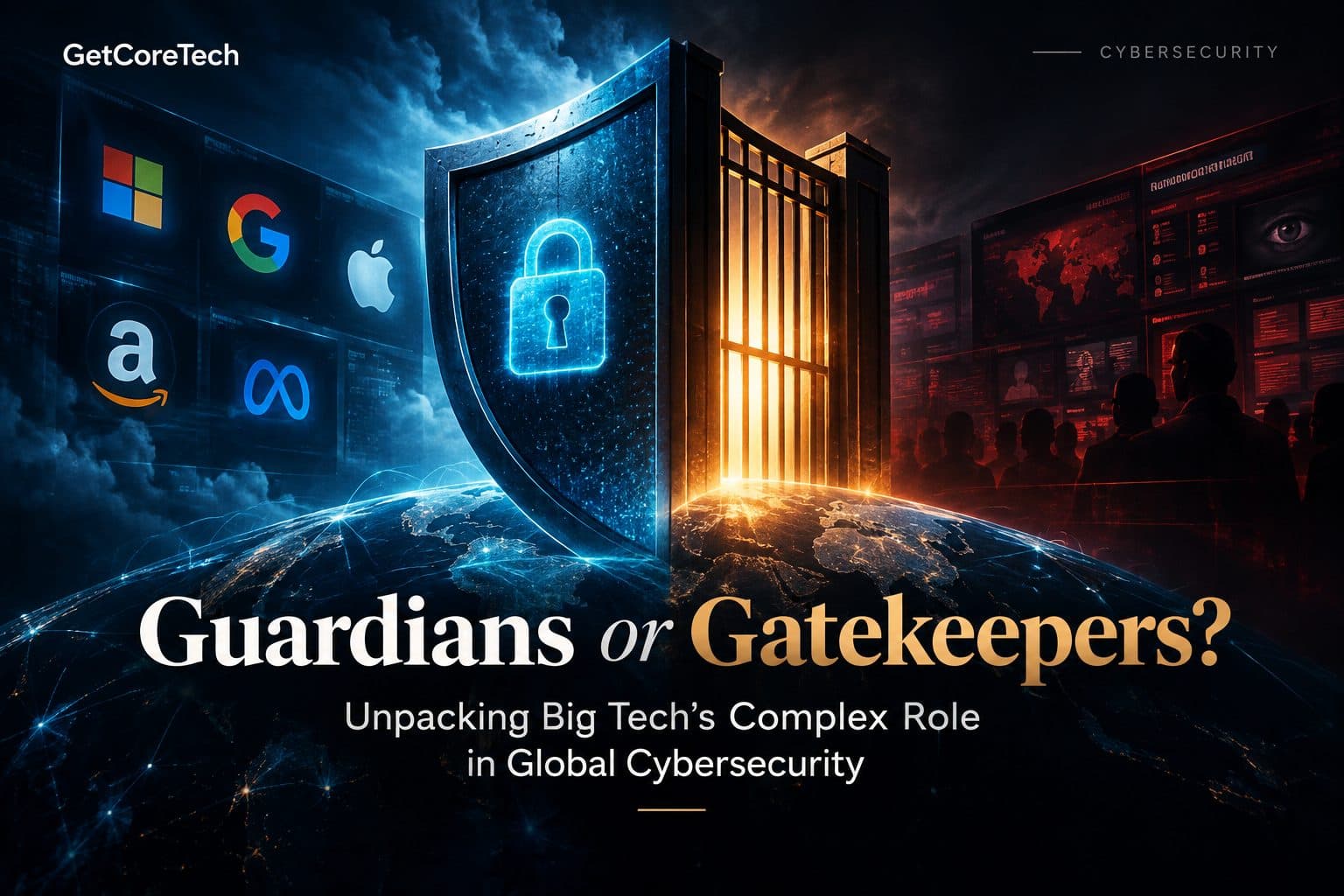
Guardians or Gatekeepers? Unpacking Big Tech's Complex Role in Global Cybersecurity
One flawed software update from a single security vendor once crashed 8.5 million Windows devices worldwide in under two hours. That's not a hypothetical — it's the clearest evidence yet of what happens when the world's digital safety net runs through a small number of private companies.
The GetCoreTech Team Aug 27, 2026 · 6 min read · Updated Sep 12, 2026
Guardians or Gatekeepers? Unpacking Big Tech's Complex Role in Global Cybersecurity
On July 19, 2024, a single flawed software update from CrowdStrike — a cybersecurity vendor most people had never heard of — crashed 8.5 million Windows devices worldwide within about 90 minutes, grounding flights, taking hospitals and 911 systems offline, and disrupting banks across multiple continents. Fortune 500 companies alone absorbed an estimated $5.4 billion in direct losses, with healthcare and banking hit hardest. That single incident is the clearest real-world proof of the tension at the center of Big Tech's role in cybersecurity: the same concentration of power that lets a handful of companies protect billions of people is also a single point of failure that can take much of the world offline at once.
Why Big Tech Ended Up Running Global Cybersecurity
Most of the internet's core infrastructure — operating systems, cloud platforms, browsers, app stores, identity systems — is controlled by a small number of companies: Google, Apple, Microsoft, Amazon, and Meta chief among them. That concentration exists because building world-class security requires resources most governments and smaller companies simply don't have: Google's Project Zero research team, Apple's Secure Enclave hardware security, Microsoft's enterprise-scale Defender platform, and Amazon Web Services' government and military-grade cloud infrastructure. Most organizations and governments rely on these companies not by choice exactly, but because no realistic alternative matches their scale.
The Guardian Case: What Big Tech Actually Prevents
The scale that creates risk also enables real protection. Google's Safe Browsing system screens billions of URLs daily to catch malicious sites before users click them. Software updates routinely patch "zero-day" vulnerabilities — flaws actively being exploited by attackers — often before most users even notice a problem existed. Widely used encryption in tools like iMessage, WhatsApp, and Signal protects ordinary communication by default, at a scale no smaller company or government could replicate. Threat-intelligence publications like Microsoft's Digital Defense Report give the wider security community early visibility into attack patterns.
The Gatekeeper Case: The Same Power, Pointed the Other Way
The same infrastructure that enables protection also gives a small number of companies outsized control over what's allowed to exist online. Apple and Google's app store policies determine whether a given app can reach billions of users at all — removal from either effectively erases an app's audience. Content moderation policies at Meta and elsewhere determine what speech is visible at global scale. And decisions about how much data to collect, ostensibly for security purposes, double as some of the most detailed behavioral profiles ever assembled about individual people.
Real Cases That Show Both Sides at Once
Apple vs. FBI (2016) — Apple refused a government request to build a tool unlocking an iPhone after a mass shooting, arguing it would weaken encryption for everyone. Guardian: protecting encryption broadly. Gatekeeper: unilaterally deciding what access even law enforcement could have.
Cambridge Analytica (2018) — Facebook's data-sharing practices allowed a political consulting firm to harvest data from tens of millions of users without meaningful consent, later used for political targeting. This was a guardian failure with a gatekeeper-scale impact.
Google Project Zero exposing government spyware — Google's security researchers have repeatedly identified surveillance tools built and used by governments, positioning Google as both a watchdog over state power and, implicitly, an authority capable of checking it.
The 2024 CrowdStrike/Microsoft outage — arguably the clearest case yet of a Big Tech-adjacent security vendor's centralized reach becoming, itself, the primary risk to global infrastructure rather than the protection against it.
Security vs. Privacy: The Trade-Off That Doesn't Fully Resolve
More effective threat detection generally requires more visibility into user behavior — more data, more device access, more monitoring. More privacy protection generally means less of that visibility, and therefore a real reduction in how quickly suspicious activity can be caught. This tension doesn't have a clean resolution; it's an ongoing negotiation between governments wanting investigative access, users wanting privacy, and companies balancing both against business incentives that don't always align neatly with either.
What This Means Practically, for Individuals and Governments
For individuals, the practical response doesn't change based on who's providing the underlying security: enable two-factor authentication, use a password manager, keep devices updated, and treat unexpected links or attachments with suspicion, regardless of which company's infrastructure sits underneath the app you're using.
For governments and large organizations, the CrowdStrike outage is a concrete argument for diversification and incident-response planning that doesn't assume any single vendor's infrastructure is infallible — building redundancy and tested rollback procedures rather than relying on scale alone as a substitute for resilience.
The Honest Bottom Line
Big Tech's role in cybersecurity isn't a story with a clean hero or villain — it's a genuine trade-off between scale-enabled protection and scale-enabled risk, playing out in real time. The 2024 outage didn't happen because a company was careless about security in the traditional sense; it happened because the entire model of relying on a small number of providers for critical infrastructure means their mistakes now happen at a scale no single mistake used to reach. That's the actual, current shape of the question — not an abstract debate about whether Big Tech is "good" or "bad," but a concrete engineering and policy problem about how much of the world's critical infrastructure should depend on how few providers.
FAQ
What actually happened in the 2024 CrowdStrike outage?
On July 19, 2024, cybersecurity vendor CrowdStrike pushed a flawed update to its Falcon sensor software, which caused a logic error crashing an estimated 8.5 million Windows devices worldwide with the "Blue Screen of Death." It disrupted airlines, hospitals, banks, and emergency services, and cost Fortune 500 companies an estimated $5.4 billion in direct losses.
Why does the CrowdStrike outage matter for the "Big Tech is too powerful" argument?
Because it's a real, measured example of the risk critics describe in the abstract: when critical global infrastructure depends on a small number of vendors, a single company's mistake can cascade into a worldwide outage within hours. It's concrete evidence rather than a hypothetical concern.
Is Big Tech mostly protecting users, or mostly controlling them?
Both, genuinely and simultaneously. The same infrastructure and scale that let companies like Google and Microsoft detect and block threats at a scale no government or smaller company can match also gives them outsized control over app distribution, content moderation, and data collection.
What was the Apple vs. FBI case about?
After a 2016 mass shooting, the FBI asked Apple to build a tool to unlock the shooter's iPhone. Apple refused, arguing that creating such a tool would weaken encryption security for all users, not just this one device. It's cited as an example of a company acting as both a guardian of broad user security and a gatekeeper making a unilateral access decision.
Do governments actually rely on Big Tech companies for their own security infrastructure?
Yes, extensively. Many government agencies use Microsoft Azure, AWS, or Google Cloud for data storage and security infrastructure, meaning these private companies' cybersecurity decisions directly affect national security, not just consumer safety.
What can an individual actually do, given how much control Big Tech has?
The practical basics still matter regardless of which company's infrastructure you're using: enable two-factor authentication, use a password manager for strong unique passwords, keep devices and software updated, and be cautious with unexpected links or attachments — most attacks still start with phishing.
Has increased reliance on a few large tech providers made global infrastructure more or less resilient?
The evidence is mixed and cuts both ways. Concentration enables faster, more sophisticated threat detection at global scale, but the 2024 CrowdStrike outage demonstrated that the same concentration means a single vendor's error can now cause disruption at a scale that used to require many independent failures to reach.
FAQ
On July 19, 2024, cybersecurity vendor CrowdStrike pushed a flawed update to its Falcon sensor software, which caused a logic error crashing an estimated 8.5 million Windows devices worldwide with the "Blue Screen of Death." It disrupted airlines, hospitals, banks, and emergency services, and cost Fortune 500 companies an estimated $5.4 billion in direct losses.
Because it's a real, measured example of the risk critics describe in the abstract: when critical global infrastructure depends on a small number of vendors, a single company's mistake can cascade into a worldwide outage within hours. It's concrete evidence rather than a hypothetical concern.
Both, genuinely and simultaneously. The same infrastructure and scale that let companies like Google and Microsoft detect and block threats at a scale no government or smaller company can match also gives them outsized control over app distribution, content moderation, and data collection.
After a 2016 mass shooting, the FBI asked Apple to build a tool to unlock the shooter's iPhone. Apple refused, arguing that creating such a tool would weaken encryption security for all users, not just this one device. It's cited as an example of a company acting as both a guardian of broad user security and a gatekeeper making a unilateral access decision.
Yes, extensively. Many government agencies use Microsoft Azure, AWS, or Google Cloud for data storage and security infrastructure, meaning these private companies' cybersecurity decisions directly affect national security, not just consumer safety.
The practical basics still matter regardless of which company's infrastructure you're using: enable two-factor authentication, use a password manager for strong unique passwords, keep devices and software updated, and be cautious with unexpected links or attachments — most attacks still start with phishing.
The evidence is mixed and cuts both ways. Concentration enables faster, more sophisticated threat detection at global scale, but the 2024 CrowdStrike outage demonstrated that the same concentration means a single vendor's error can now cause disruption at a scale that used to require many independent failures to reach.
The GetCoreTech Team
We write about the SaaS, AI, and infrastructure decisions builders actually have to make.
Comments
Log in or sign up to join the discussion.
Loading comments…