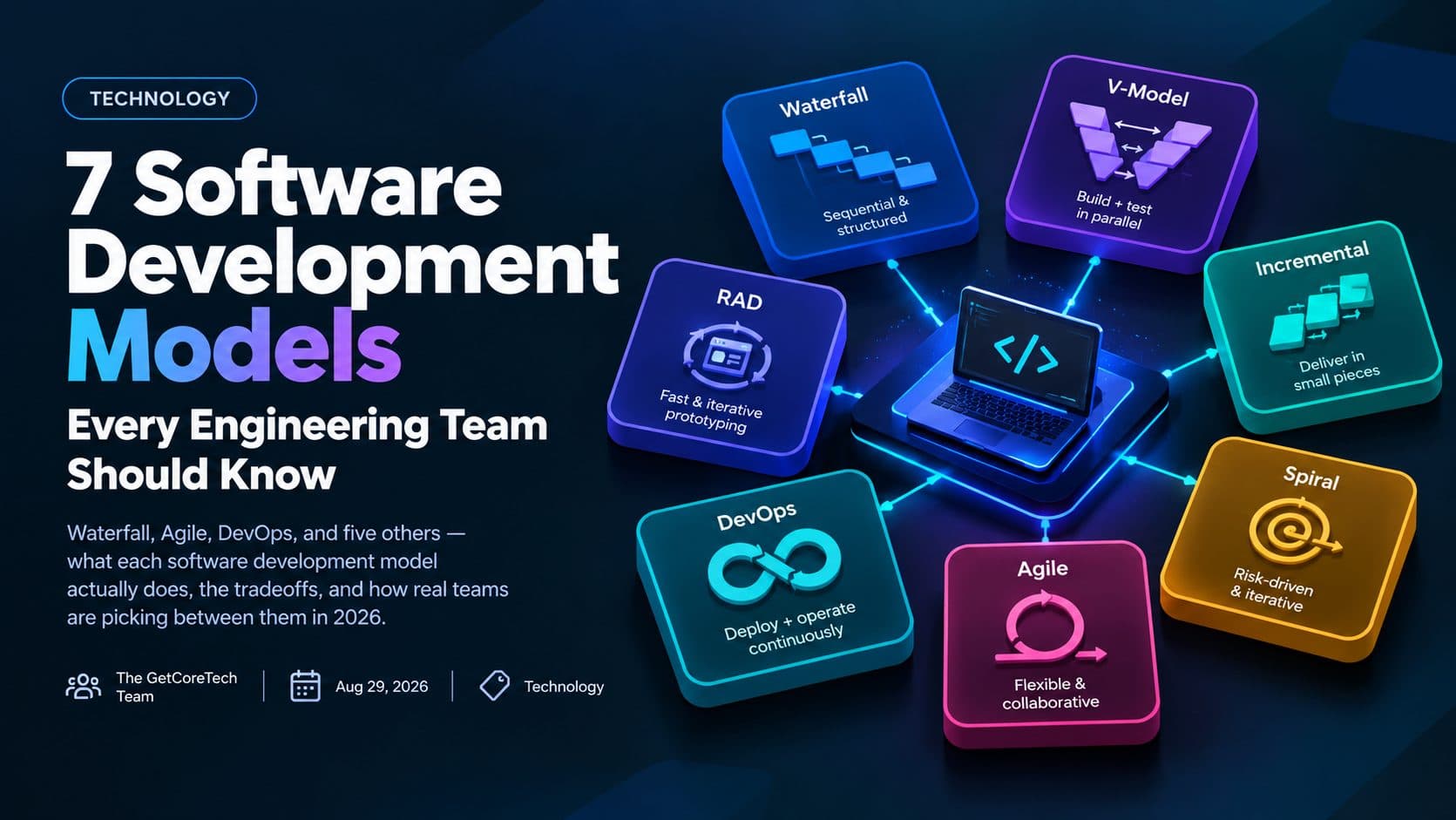
7 Software Development Models Every Engineering Team Should Know
A software development model is a structured approach engineering teams use to plan, build, test, and deliver software — and there are seven models worth knowing: Waterfall, V-Model, Incremental, Spiral, Agile, DevOps, and Rapid Application Development (RAD). Each fits different project sizes, risk levels, and how much requirements are expected to change, and most real-world teams today use a blended mix rather than following one model by the book.Why Engineering Teams Use Development Models
Modern software has to work securely and reliably at scale, which means every project needs a plan for requirements gathering, design, coding, testing, and delivery — doing this in an ad hoc way tends to produce missed deadlines, budget overruns, and low-quality releases. The most widely referenced framework for this is ISO/IEC/IEEE 12207, a joint standard from ISO, IEC, and IEEE that defines the processes and terminology used across the software life cycle, from acquisition through development, operation, and eventual retirement. The standard itself doesn't mandate a specific model — it's compatible with Waterfall, Agile, and everything between — which is part of why so many named models exist to fill in the "how" underneath it. There is no single best model for every project. The right choice depends on project size, how firm the requirements are, risk tolerance, timeline, and how involved the customer needs to be throughout.1. Waterfall Model
Waterfall is the oldest and most rigid of the seven: requirements analysis, system design, implementation, testing, deployment, and maintenance happen in strict sequence, with each phase completed before the next begins. Advantages include being simple to understand and manage, producing clear documentation, and working well for small projects with fixed requirements. Disadvantages include being very difficult to accommodate change, testing happening late, and customer feedback arriving too late to act on cheaply. Best for small projects with fixed, well-understood requirements and stable technology.2. V-Model (Verification and Validation Model)
The V-Model extends Waterfall by pairing every development phase with a corresponding testing phase — unit testing mirrors module design, integration testing mirrors architecture design, and so on. This structure is common in safety-critical domains like medical devices and aerospace, where the testing terminology and practices are formalized by organizations like the International Software Testing Qualifications Board (ISTQB). Advantages include early defect detection, strong quality assurance discipline, and clear role separation. Disadvantages include rigidity, difficulty adapting mid-project, and heavy documentation requirements. Best for regulated industries and mission-critical systems with stable requirements.3. Incremental Model
The Incremental model splits software into smaller pieces ("increments"), each of which is designed, built, tested, and released before moving to the next — so users get working software early instead of waiting for one final release. Advantages include early delivery of working software, easier risk management, and room to incorporate feedback as you go. Disadvantages include requiring solid upfront planning so increments integrate cleanly, and the need to manage overall system design carefully across releases. Best for projects where requirements can be cleanly divided and early user feedback matters.4. Spiral Model
The Spiral model combines iterative development with structured risk management, cycling repeatedly through planning, risk analysis, engineering, and evaluation. It was introduced by Barry Boehm in his 1986 paper "A Spiral Model of Software Development and Enhancement," published in IEEE Computer — one of the most cited papers in software engineering, largely because it was the first model to explain why iteration reduces risk rather than just prescribing it. Advantages include strong risk management, adaptability, catching problems early, and suitability for large complex systems. Disadvantages include the expense of running it properly, the need for genuine risk-analysis expertise, and being overkill for small projects. Best for large, high-risk, long-running enterprise systems with requirements that will evolve.5. Agile Model
Agile organizes work into short cycles ("sprints") and prioritizes responding to change over following a fixed plan — principles laid out in the 2001 Agile Manifesto. Common frameworks under the Agile umbrella include Scrum, Kanban, Extreme Programming (XP), and Lean. Agile's real-world usage looks less "pure" than its reputation suggests. According to Digital.ai's 18th State of Agile Report (2025), Scrum remains the default at the team level — 63% of Agile teams use it — but 74% of organizations now run a hybrid, blended, or homegrown approach rather than any single framework by the book, and Scaled Agile Framework (SAFe) leads enterprise-level scaling frameworks at 44% adoption. Advantages include high flexibility, fast delivery cycles, and continuous feedback loops. Disadvantages include needing strong team collaboration and experience, producing less formal documentation, and being harder to run on fixed-scope contracts. Best for projects with frequently changing requirements, high customer involvement, and a premium on speed.6. DevOps Model
DevOps is less a single process model and more a culture and set of practices — continuous integration, continuous delivery, infrastructure as code, automated testing, and monitoring — aimed at collapsing the traditional wall between development and operations teams. The clearest current signal on DevOps comes from Google's 2025 DORA Report ("State of AI-Assisted Software Development"), based on nearly 5,000 survey responses. It found 90% of respondents now use AI in their daily development work, and that AI-tool adoption jumped from 68% to 84% among Agile/DevOps practitioners in a single year — the fastest single-year increase the report has tracked. But the same report found a real tradeoff worth knowing: increased AI adoption correlated with increased software delivery instability, even as it improved individual developer output, largely because AI increases the rate of code generation faster than review and deployment pipelines can absorb it. DORA also retired its old four-tier "elite/high/medium/low" performer model this year in favor of seven team archetypes that account for factors like burnout and coordination friction, not just throughput. Advantages include faster and more frequent releases, better cross-team collaboration, and faster incident recovery. Disadvantages include requiring real cultural change, non-trivial automation investment upfront, and — per the 2025 data — needing deliberate governance to keep AI-driven speed from outrunning delivery stability. Best for cloud-based applications, frequent-release environments, and organizations already prioritizing speed and reliability together.7. Rapid Application Development (RAD) Model
RAD prioritizes speed and user feedback over long planning phases, relying on prototypes and reusable components. It moves through requirement planning, user design, rapid construction, and cutover. The model was popularized by James Martin in his 1991 book on the subject and remains most associated with UI-heavy, prototype-driven projects. Advantages include very fast development cycles, high user involvement, flexible design, and early testing. Disadvantages include poor scalability to large systems and the need for experienced developers and active user participation throughout. Best for small-to-medium projects with tight deadlines and a strong UI/prototyping component.How to Choose the Right Model
For fixed, well-understood requirements on a small project, Waterfall is the fit. For safety-critical or heavily regulated systems, V-Model. When requirements can be cleanly split and early feedback matters, Incremental. For large, high-risk, long-running systems, Spiral. When requirements change often and speed and customer involvement matter, Agile. For frequent releases, cloud infrastructure, and cross-team collaboration, DevOps. For a tight deadline on a UI-focused, prototype-driven project, RAD.
In practice, most engineering organizations blend elements of several models rather than adopting one wholesale — the 2025 State of Agile data above (74% hybrid/blended) confirms this is now the norm rather than the exception.
Comments
Log in or sign up to join the discussion.
Loading comments…