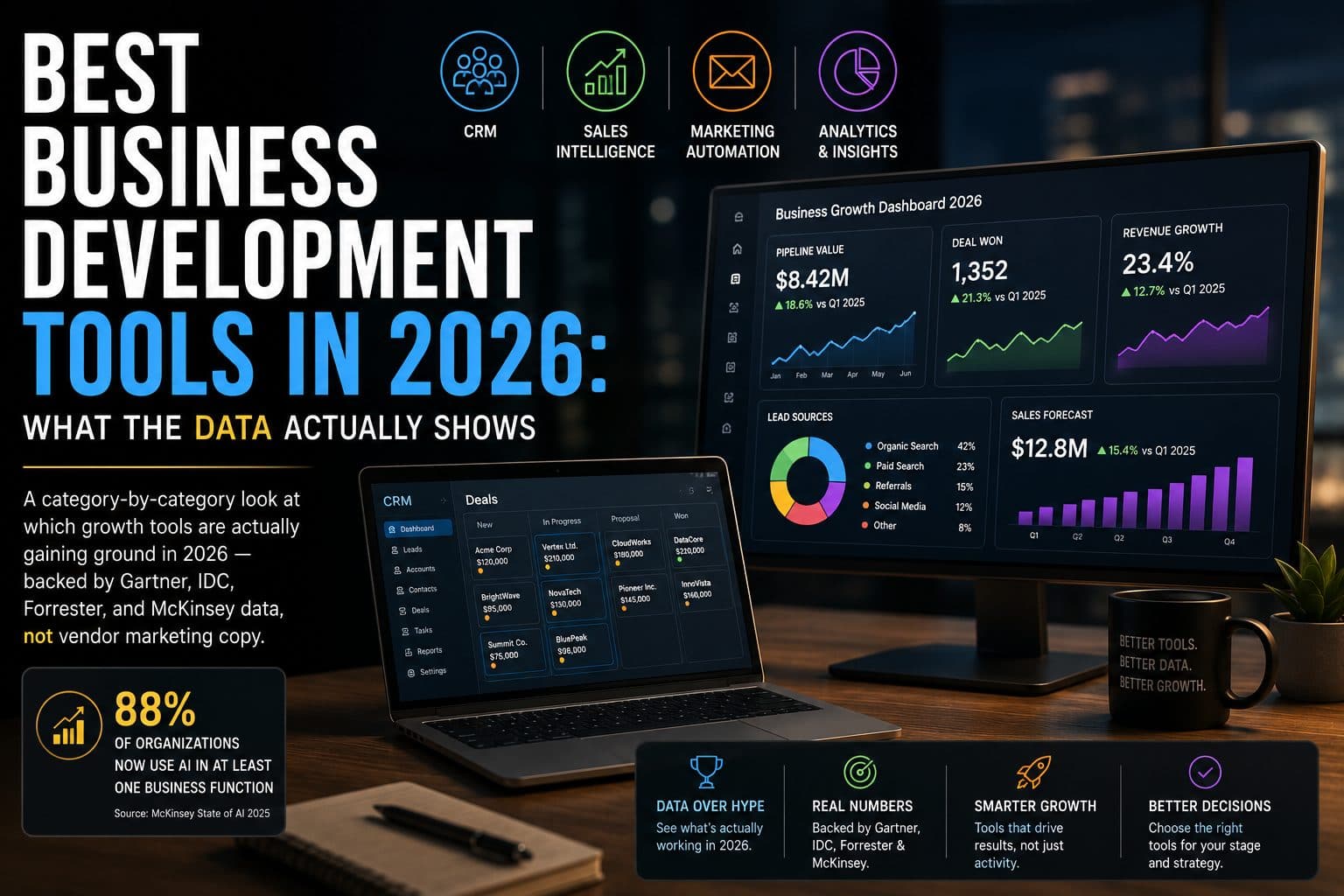
Best Business Development Tools in 2026: What the Data Actually Shows
A category-by-category look at which growth tools are actually gaining ground in 2026 — backed by Gartner, IDC, Forrester, and McKinsey data, not vendor marketing copy.
The GetCoreTech Team Aug 30, 2026 · 9 min read · Updated Sep 11, 2026
Best Business Development Tools in 2026: What the Data Actually Shows
Business development in 2026 runs on a smaller set of tool categories than most "top tools" lists suggest — CRM, AI-assisted sales intelligence, marketing automation, and analytics — and the real story isn't which vendor has the flashiest AI feature. It's that adoption has become nearly universal while the gap between companies that get measurable value and those that don't has widened sharply. According to McKinsey's most recent State of AI research, 88% of organizations now use AI in at least one business function, but fewer than one in ten qualify as "high performers" capturing meaningful financial return from it, and nearly two-thirds haven't scaled their AI use past pilot projects.
Why the Tool Conversation Has Shifted
Three years ago, adopting a CRM or a marketing automation platform was itself a differentiator. That's no longer true. The differentiator now is whether a company can operationalize the data these tools generate — not whether it owns the tools.
That shift shows up clearly in how Gartner evaluates the CRM category. Its research organization retired the older "Sales Force Automation" framing in 2026 in favor of a new "CRM Sales Platforms" Magic Quadrant, which judges vendors on whether their AI can actually qualify a lead, progress a deal, and improve forecast accuracy — not just summarize a call or draft a follow-up email.
1. CRM Platforms: Still the Backbone, But the Ranking Shifted
CRM remains the system most business development work runs through — pipeline tracking, customer history, and forecasting all live there. But the competitive picture changed meaningfully in 2026.
In Gartner's 2026 Magic Quadrant for CRM Sales Platforms, Salesforce and Microsoft retained their positions as Leaders. Oracle, which had been a Leader in 2025, dropped into the Challenger quadrant. HubSpot made the largest jump in the other direction, moving from Niche Player to Challenger — a shift Gartner attributed to improvements in seller experience and high-velocity sales execution.
On raw market share, the gap between the top vendor and everyone else is still wide. IDC's Worldwide Semiannual Software Tracker, published in its April 2026 edition, put Salesforce at 20% of global CRM software revenue for 2025 — the highest share in the market, with no other vendor above 5%. But growth rate tells a different story: HubSpot reported 299,458 paying customers and $3.45 billion in annual recurring revenue as of Q1 2026, with revenue growing roughly 23% year over year, compared to Salesforce's 8–11% growth in the same period. HubSpot isn't catching Salesforce on scale, but it's the CRM vendor gaining the most ground relative to its size, particularly in the SMB and mid-market segments.
2. AI-Powered Sales Intelligence Tools
Sales intelligence tools — platforms that score leads and flag buying signals from email, web, and social activity — have moved from a nice-to-have to standard sales-stack infrastructure.
According to Salesforce's State of Sales research, 81% of sales professionals now use AI at least occasionally in their workflow, up from 54% in 2024 and just 24% in 2022. The underlying market reflects that trajectory: Global Market Insights valued the AI-in-sales market at $39.4 billion in 2025, projecting it to reach $50.8 billion in 2026 on a compound annual growth rate near 29%, with sales forecasting and analytics the largest segment.
The practical value isn't the AI label — it's what these tools change: which leads get worked first, when outreach happens, and which message a rep sends. Tools that plug directly into an existing CRM tend to see the highest actual usage, since reps don't have to leave their primary workflow to act on the signal.
3. Marketing Automation
Marketing automation — email sequencing, lead nurturing, campaign tracking — remains one of the most heavily adopted categories, but it's worth flagging that market-size estimates for 2026 vary enormously depending on how a research firm defines the category: figures range from roughly $8 billion (software-only estimates from Fortune Business Insights and The Business Research Company) up to $47 billion when "AI-powered marketing automation" is measured as its own broader segment. Rather than cite a single disputed number, the more reliable trend across these reports is directional: AI features (predictive send-time optimization, generative content drafting, dynamic segmentation) are increasingly bundled into existing platforms rather than sold as standalone add-ons, and adoption is concentrated in a handful of large platforms rather than spread evenly across hundreds of vendors.
4. Business Intelligence and Analytics Tools
Analytics platforms turn CRM and marketing data into decisions. Microsoft Power BI has held the Leader position in Gartner's Magic Quadrant for Analytics and Business Intelligence Platforms for more than a decade running, helped by aggressive pricing and deep integration with Microsoft 365 — a combination that's made it the default choice for organizations already inside that ecosystem. Tableau, now owned by Salesforce, remains a Leader as well, with a stronger reputation for complex, exploratory visualization work.
The practical guidance hasn't changed much: BI tools only produce value when the underlying data is clean and someone owns the reporting process. A well-configured dashboard on a mediocre platform beats a powerful platform fed messy data.
5. Customer Experience and Feedback Tools
Customer experience investment is showing a real, measurable turnaround after several difficult years. Forrester's 2026 Global Customer Experience Index — based on more than 224,000 customer evaluations of 462 brands across 13 industries and 13 countries, published in June 2026 — found that 26% of North American brands posted statistically significant CX score gains against just 7% that declined. That's a reversal after multiple consecutive years in which more brands were declining than improving.
Feedback and survey platforms (Qualtrics is the most established name in this space) remain the primary way companies collect this data systematically, but the Forrester findings suggest the harder work is acting on it — reducing customer effort and improving consistency across channels, not just measuring satisfaction.
6. Collaboration and Productivity Tools
Slack, Asana, and similar platforms don't directly drive growth the way a CRM or analytics tool does, but they determine how fast a growth strategy actually gets executed. Their role in 2026 is less about new features and more about reducing the coordination overhead that comes from running go-to-market work across sales, marketing, and product teams simultaneously.
7. Financial Planning and Forecasting Tools
Revenue forecasting and expense tracking tools (QuickBooks remains the most widely used platform among small and mid-sized businesses) matter most when growth spending is increasing — which it is, given the AI tooling spend discussed above. The core discipline here hasn't changed: forecast against real historical data, not target numbers, and revisit the forecast monthly rather than quarterly when spending on new tools is accelerating.
8. Customer Support Platforms
Support tools like Zendesk sit downstream of growth — every new customer a growth strategy brings in eventually needs support — and increasingly overlap with the AI-forecasting and CX categories above, since response-time and resolution data now feed directly into the same dashboards sales and marketing teams use.
How to Choose Between These Categories
Start from a specific gap, not a category. "We lose visibility on deals after the first call" points to a CRM or sales intelligence gap; "we can't tell which campaigns are working" points to analytics.
Check integration before features. A tool that doesn't sync cleanly with the CRM you already run creates a second source of truth, which tends to cost more in reconciliation time than it saves.
Weigh vendor security posture, not just price. For any tool that will touch customer data, NIST's Cybersecurity Framework is a useful, vendor-neutral reference point for evaluating what a prospective SaaS vendor should be able to show you about its own security practices.
Budget for training time, not just license cost. Tool underuse — not tool choice — is the more common failure mode.
Where This Is Headed
The clearest signal in the current data is the widening gap McKinsey identified between AI adoption and AI value: near-universal usage, but a small minority actually capturing measurable financial return. That gap is likely to keep shaping which vendors gain share in 2027 — the ones helping customers close it, rather than just adding another AI feature to a press release, are the ones showing up as Leaders and Challengers in this year's analyst rankings.
FAQ
Is Salesforce still the leading CRM platform in 2026?
Yes. IDC's April 2026 tracker put Salesforce at 20% of global CRM software revenue for 2025, the highest of any vendor, with no competitor above 5%. Gartner's 2026 Magic Quadrant for CRM Sales Platforms also named Salesforce a Leader alongside Microsoft.
Is HubSpot catching up to Salesforce?
Not on overall market share, but it's growing faster. HubSpot reported roughly 23% year-over-year revenue growth in Q1 2026 versus Salesforce's 8–11%, and Gartner moved HubSpot from Niche Player to Challenger status in its 2026 CRM Magic Quadrant.
How many sales teams are actually using AI tools in 2026?
According to Salesforce's State of Sales research, 81% of sales professionals report using AI at least occasionally, up sharply from 54% in 2024 and 24% in 2022.
What's the difference between AI adoption and AI value in business tools?
McKinsey's State of AI research found that 88% of organizations use AI in at least one business function, but only a small minority — around 6% — report significant financial return from it, and nearly two-thirds haven't scaled AI beyond pilot projects. Adoption and measurable ROI are two separate metrics.
Which business intelligence tool is the market leader?
Microsoft Power BI has held the Leader position in Gartner's Magic Quadrant for Analytics and Business Intelligence Platforms for more than a decade, driven largely by aggressive pricing and Microsoft 365 integration. Tableau, owned by Salesforce, is also consistently named a Leader.
Is customer experience investment actually paying off in 2026?
The trend is improving. Forrester's 2026 Global Customer Experience Index found 26% of North American brands posted statistically significant score gains versus 7% that declined — a reversal after several consecutive years in which declines outpaced gains.
How big is the marketing automation market in 2026?
Estimates vary widely by research firm and category definition, ranging from roughly $8 billion for software-only estimates to $47 billion when AI-powered marketing automation is counted as a distinct category. There isn't yet a single authoritative figure, so treat any specific market-size number in this category with some skepticism.
What should a business check before adopting a new growth tool?
Beyond features and price, check integration with existing systems (a tool that doesn't sync with your CRM creates a second source of truth) and the vendor's security practices — NIST's Cybersecurity Framework is a useful, non-vendor reference point for evaluating what a SaaS provider should be able to demonstrate about data protection.
Why did Oracle drop out of the CRM Leaders category in 2026?
Gartner moved Oracle from Leader to Challenger in its 2026 Magic Quadrant for CRM Sales Platforms. Gartner's report attributed the shift to the market's redefinition around AI-driven, end-to-end sales workflow orchestration rather than traditional sales force automation features.
FAQ
Yes. IDC's April 2026 tracker put Salesforce at 20% of global CRM software revenue for 2025, the highest of any vendor, with no competitor above 5%. Gartner's 2026 Magic Quadrant for CRM Sales Platforms also named Salesforce a Leader alongside Microsoft.
Not on overall market share, but it's growing faster. HubSpot reported roughly 23% year-over-year revenue growth in Q1 2026 versus Salesforce's 8–11%, and Gartner moved HubSpot from Niche Player to Challenger status in its 2026 CRM Magic Quadrant.
According to Salesforce's State of Sales research, 81% of sales professionals report using AI at least occasionally, up sharply from 54% in 2024 and 24% in 2022.
McKinsey's State of AI research found that 88% of organizations use AI in at least one business function, but only a small minority — around 6% — report significant financial return from it, and nearly two-thirds haven't scaled AI beyond pilot projects. Adoption and measurable ROI are two separate metrics.
Microsoft Power BI has held the Leader position in Gartner's Magic Quadrant for Analytics and Business Intelligence Platforms for more than a decade, driven largely by aggressive pricing and Microsoft 365 integration. Tableau, owned by Salesforce, is also consistently named a Leader.
The trend is improving. Forrester's 2026 Global Customer Experience Index found 26% of North American brands posted statistically significant score gains versus 7% that declined — a reversal after several consecutive years in which declines outpaced gains.
Estimates vary widely by research firm and category definition, ranging from roughly $8 billion for software-only estimates to $47 billion when AI-powered marketing automation is counted as a distinct category. There isn't yet a single authoritative figure, so treat any specific market-size number in this category with some skepticism.
Beyond features and price, check integration with existing systems (a tool that doesn't sync with your CRM creates a second source of truth) and the vendor's security practices — NIST's Cybersecurity Framework is a useful, non-vendor reference point for evaluating what a SaaS provider should be able to demonstrate about data protection.
Gartner moved Oracle from Leader to Challenger in its 2026 Magic Quadrant for CRM Sales Platforms. Gartner's report attributed the shift to the market's redefinition around AI-driven, end-to-end sales workflow orchestration rather than traditional sales force automation features.
The GetCoreTech Team
We write about the SaaS, AI, and infrastructure decisions builders actually have to make.
Comments
Log in or sign up to join the discussion.
Loading comments…