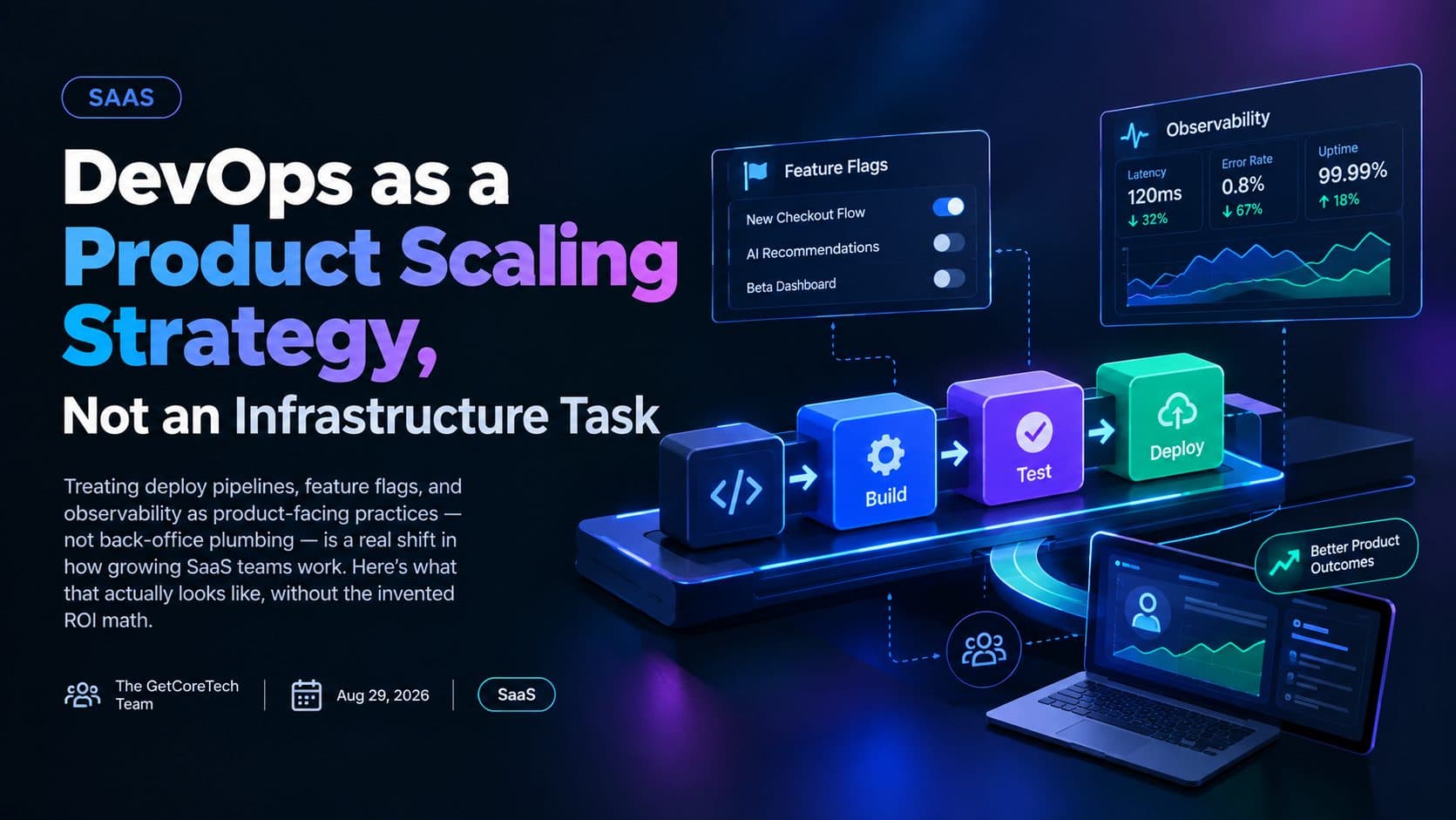
DevOps as a Product Scaling Strategy, Not an Infrastructure Task
Product-led DevOps means treating deploy pipelines, feature flags, and observability as things that affect the product experience directly — not just internal infrastructure hygiene. In practice, that means measuring pipeline health the way you'd measure a feature's performance, rolling out changes gradually to real users instead of all at once, and wiring monitoring into product decisions rather than just incident response. The underlying delivery metrics behind this shift are real and well-studied, even though many of the specific growth-hack case studies attached to this idea online are not.Why This Framing Matters
The old framing of DevOps as "plumbing" — something operations handles quietly in the background — undersells what deploy pipelines, rollout mechanisms, and monitoring actually do for a growing product. When a pipeline is slow or brittle, every feature ships slower. When rollouts are all-or-nothing, every release is a bigger risk than it needs to be. When observability is limited to "is the server up," teams lose the ability to see whether a feature is actually working for users, not just whether it's technically running. Treating these as product-facing concerns — with their own metrics, reviews, and ownership — is a legitimate operational shift, distinct from simply buying more tooling.What the Current Data Actually Shows
Google's 2025 DORA Report ("State of AI-Assisted Software Development"), based on nearly 5,000 survey responses, found that AI tool adoption among software delivery teams jumped from 68% to 84% in a single year — the fastest year-over-year increase the report has tracked. But it also found a real tradeoff: increased AI adoption correlated with increased software delivery instability, even as it improved individual developer output, largely because AI increases the rate of code generation faster than review and deployment infrastructure can absorb it. This is the opposite of a clean "more automation, more reliability" story, and it's a more useful data point for a scaling SaaS team than any invented ARR multiplier. The same report also retired its long-standing four-tier Elite/High/Medium/Low performance model, replacing it with seven "team archetypes" that combine delivery throughput with human factors like burnout and coordination friction. The underlying metrics — deployment frequency, lead time for changes, change failure rate, and time to restore service — are still the right things to track. What's changed is that DORA no longer treats climbing a single performance ladder as the goal; a team can look fast on paper and still be unsustainable. Separately, Digital.ai's 18th State of Agile Report (2025) found that 74% of organizations now run a hybrid or blended delivery approach rather than following one framework by the book — a useful reminder that the practices below are meant to be adapted, not adopted wholesale as a checklist.Core Practice 1: Treat the Pipeline Like a Product Surface
This means giving the deploy pipeline the same attention a team would give a product feature: track deployment frequency and lead time for changes as real metrics, review pipeline health in regular team meetings rather than only when something breaks, and treat a slow or flaky pipeline as a product problem — because it directly limits how fast anything else can ship. The two DORA throughput metrics (deployment frequency and lead time) are the standard way to measure this, and they're genuinely useful even without a company case study attached.Core Practice 2: Progressive Rollouts Instead of All-or-Nothing Releases
Feature flagging — shipping code to a small percentage of users first, then expanding gradually based on real usage — is a well-established practice, not a growth hack. Tools like LaunchDarkly and the open-source GrowthBook implement this pattern; the CNCF-adjacent GitOps ecosystem (ArgoCD, Flux) implements a similar staged-rollout philosophy at the infrastructure level. The genuine benefit is risk reduction: a bad change affects a small slice of users and can be reversed quickly, rather than affecting everyone at once. Specific conversion-lift percentages vary enormously by product and aren't something that transfers meaningfully from one company's case study to another — treat any specific number here skeptically, including in vendor marketing.Core Practice 3: GitOps for Auditable, Reversible Deploys
GitOps — a term coined by Weaveworks in 2017 — means using Git as the single source of truth for infrastructure and deployment state, so changes to production go through the same pull-request review process as code changes. Tools like ArgoCD and Flux (both CNCF projects) implement this for Kubernetes environments. The real benefit is auditability and reversibility: every production change has a reviewable diff and a clear rollback path, which matters more as a team and its blast radius grow.Core Practice 4: Observability Tied to Product Metrics, Not Just Uptime
Traditional monitoring answers "is the server up." Product-facing observability goes further — connecting technical signals (error rates, latency) to product signals (feature adoption, conversion, user-reported issues) so a team can tell whether a change is actually working, not just whether it's technically deployed. This is the practical logic behind canary-style rollouts: watch a small set of real usage signals before expanding a change to everyone, and roll back automatically if they degrade.How to Sequence This as You Scale
Early stage: get deployment frequency and lead time under control first — a fast, boring, reliable pipeline is the foundation everything else builds on. Growing stage: add feature flagging for risky changes and basic dashboards connecting deploys to error rates, so releases stop being all-or-nothing bets.Scaling stage: move toward GitOps-style auditability and deeper observability tied to product metrics, and start tracking DORA's stability metrics (change failure rate, recovery time) alongside throughput — speed without stability isn't the win it looks like.
There's no universal budget or tool stack that fits every team at every stage — that depends on team size, cloud spend, and existing infrastructure far too much to generalize responsibly. What's consistent across the DORA and State of Agile data is the direction: measure delivery like a product concern, and treat rollout risk as something to manage gradually rather than eliminate through more process.
Comments
Log in or sign up to join the discussion.
Loading comments…