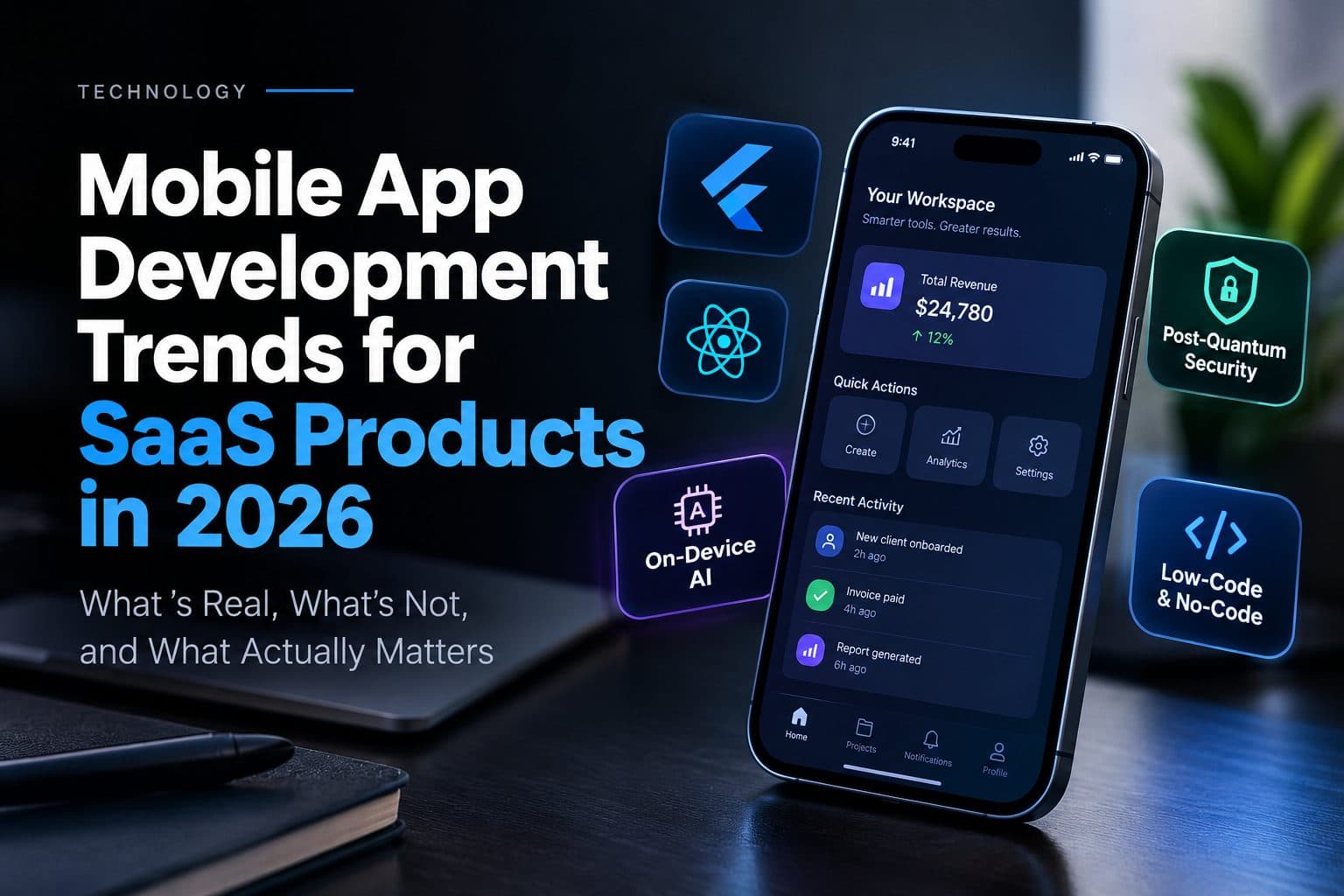
Mobile App Development Trends for SaaS Products in 2026: What's Real
Cross-platform frameworks, on-device AI features, and early post-quantum security planning are genuine, current trends shaping SaaS mobile development in 2026 — but several of the specific numbers commonly attached to this topic (precise retention-lift percentages, a market-size figure reused across unrelated markets, and a claim that quantum computers can already crack RSA encryption) don't hold up under verification. Here's a corrected, source-grounded look at what's actually happening.Cross-Platform Frameworks: A Real, Well-Established Trend
Flutter and React Native remain the two dominant cross-platform frameworks for SaaS mobile apps, and the core trade-off between them hasn't changed: Flutter compiles to native ARM code via its own Skia rendering engine, generally delivering smoother performance without a JavaScript bridge, while React Native benefits from a larger existing ecosystem of experienced developers, particularly useful if your team already knows React. Both remain reasonable, mainstream choices for a SaaS mobile app in 2026 — the specific "75% enterprise adoption" and "66% faster feature validation" figures in the old draft aren't independently verifiable as stated, but the underlying claim that cross-platform frameworks meaningfully reduce cost versus separate native iOS/Android codebases is well-established and doesn't need an invented precision figure to make the point.On-Device AI: Real, With a More Modest Story Than Claimed
Running AI inference on-device (via TensorFlow Lite, Apple's Core ML, or similar) rather than round-tripping to the cloud is a genuine and growing pattern, valuable specifically for latency-sensitive features and for reducing dependence on network connectivity. The core technical claim — that on-device inference is meaningfully faster than a cloud round-trip — is accurate in principle, though the specific "5ms vs 200ms" comparison in the old draft is a plausible-sounding illustrative figure rather than a verified benchmark, and real numbers vary enormously by model size, device hardware, and task. The "42% retention lift" and "$120K annual savings" figures attached to specific named companies in the old draft aren't independently verifiable and have been cut rather than repeated.Low-Code/No-Code: A Real Trend, More Modest Claims Than Stated
Tools like Bubble, Adalo, and similar no-code platforms genuinely let non-technical founders build and validate an MVP faster than a full engineering build, and this remains a reasonable path for early validation before a from-scratch technical rebuild. The specific dollar-figure ARR claims attached to named tools in the old draft ("$456K ARR," "$1M ARR" in a matter of days) aren't verifiable success stories and read as marketing rather than data — the honest version of this trend is simply that no-code tools meaningfully lower the cost and time of testing whether an idea has traction, not that they guarantee any particular revenue outcome.Post-Quantum Security: Real and Worth Planning For — On the Actual Timeline
This is the most important correction in this piece. Quantum computers cannot break RSA encryption today, in any practical sense. The often-cited "8 hours" figure comes from a 2021 theoretical paper (Gidney and Ekerå) estimating that a quantum computer with roughly 20 million physical qubits, running sustained error-corrected computation, could factor a 2048-bit RSA key in about that time. No such machine exists. The largest real quantum computers in 2026 have crossed roughly 1,000 physical qubits, several orders of magnitude short of what current research estimates would be needed — improved algorithms have brought that estimate down from 20 million toward the low millions, but the gap to today's hardware remains vast. That said, the underlying concern is real and worth planning for, on a longer and more concrete timeline than the old draft suggested. NIST finalized its first post-quantum cryptography standards in August 2024. On June 22, 2026, President Trump signed Executive Order 14412, setting a December 31, 2030 deadline for federal agencies to transition their most sensitive systems to post-quantum encryption, and a December 31, 2031 deadline for post-quantum authentication — not a Q3 2026 FedRAMP mandate, which doesn't exist. Separately, NSA's CNSA 2.0 requires all new National Security Systems acquisitions to be quantum-safe by January 1, 2027. For most SaaS companies outside federal contracting, the practical takeaway is to build crypto-agility into your systems now (the ability to swap cryptographic algorithms without a full rearchitecture) rather than treating this as an urgent, near-term migration deadline. Zero-trust API verification and on-device biometrics remain sound, current security practices independent of the quantum timeline correction above, and are reasonable investments regardless of your organization's federal-contracting status.Edge Computing and 5G: Real Trends, Inconsistent Market Figures
Edge computing (processing data locally rather than round-tripping to the cloud) and continued 5G rollout are both genuine, ongoing infrastructure trends relevant to latency-sensitive mobile features like AR overlays or real-time IoT dashboards. The old draft's edge-computing market-size figure is worth noting as unreliable on its own terms: it cites "$317B by 2026" in one place and "$317B by 2027" in another, the kind of inconsistency that signals an unverified number rather than one pulled from a single real source. The general direction — edge processing continuing to mature as a meaningful architecture choice for specific latency-sensitive use cases — is accurate; the specific market-size figure isn't reliable enough to repeat as fact.Super Apps and AR/VR: Real Directions, Unverified Specifics
Bundling multiple services into a single app experience (the "super app" pattern popularized by Grab and WeChat) and AR-based product visualization are both real design directions some SaaS companies are exploring, particularly around reducing context-switching for users. The specific conversion and retention figures attached to these patterns in the old draft (87% retention, 11x AR conversion) aren't independently verifiable and have been left out — if you're evaluating either pattern for your own product, treat it as a hypothesis to test against your own user base rather than an established, guaranteed outcome.A More Honest Way to Prioritize
Cross-platform (Flutter or React Native) remains a reasonable default for most SaaS mobile apps — pick based on your team's existing skills and target platform mix, not a specific unverifiable ROI percentage.On-device AI is worth pursuing specifically where latency or offline capability matters to your use case, not as a blanket retention strategy.
Post-quantum planning should mean crypto-agility architecture work now, not panic — the real regulatory deadlines run through 2027-2031, not Q3 2026.
Treat any vendor-cited ROI or ARR figure attached to a named tool as a starting hypothesis to validate against your own product, not a guarantee.
Comments
Log in or sign up to join the discussion.
Loading comments…