Beyond the Bill: A Practical Guide to SaaS FinOps in 2026
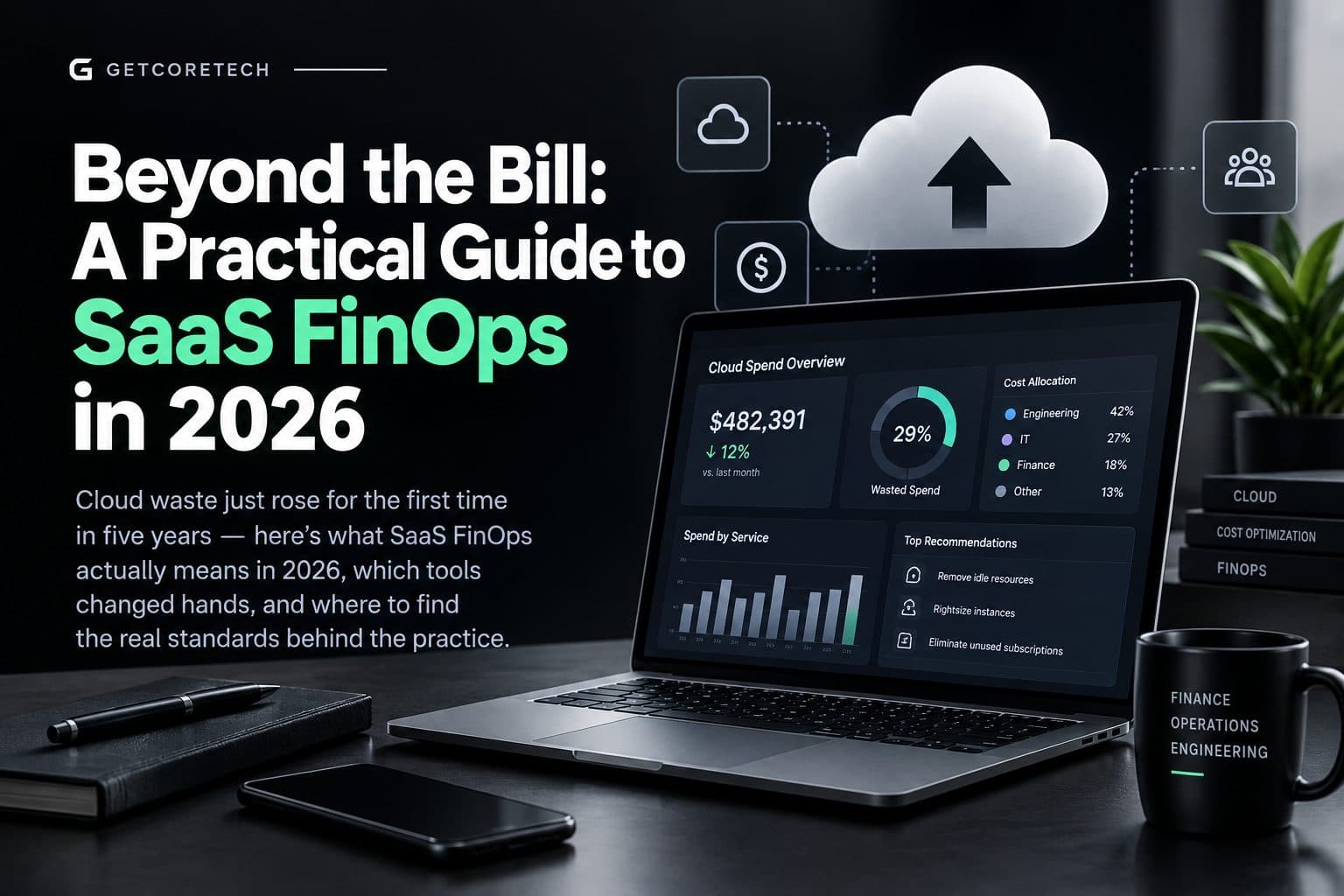
Cloud waste just rose for the first time in five years, driven largely by AI workloads — here's what SaaS FinOps actually means in 2026, which tools changed hands, and where to find the real standards body behind the practice.
The GetCoreTech Team Aug 29, 2026 · 9 min read · Updated Sep 11, 2026
Beyond the Bill: A Practical Guide to SaaS FinOps in 2026
SaaS FinOps is the practice of bringing finance, operations, and engineering teams together to track, forecast, and optimize cloud and SaaS spend — and it matters more in 2026 than it did even a year ago, because cloud waste just rose for the first time in five years. Flexera's 2026 State of the Cloud Report, surveying 753 cloud decision-makers, found estimated wasted IaaS/PaaS spend ticked up to 29%, reversing a five-year decline, largely driven by the cost complexity of AI workloads and new pricing models.
What Changed Since This Was Last Accurate
A few of the tools commonly recommended for FinOps have changed ownership, which affects how you'd actually buy or evaluate them today. CloudHealth by VMware is now Tanzu CloudHealth under Broadcom, following Broadcom's 2023 acquisition of VMware. Since May 2024, it's sold exclusively through Arrow Electronics rather than directly. Apptio Cloudability is now IBM Cloudability, following IBM's 2023 acquisition of Apptio — the standalone Apptio brand is being phased out. CloudCheckr, previously owned by NetApp, was sold to Flexera in January 2025 for roughly $100 million and now sits alongside Spot and ProsperOps in Flexera's FinOps portfolio. BetterCloud, Torii, and CloudZero remain independent and actively developed as of 2026.
None of this means these tools stopped working — they're all still live, actively updated products. It does mean pricing, support paths, and purchasing (Broadcom's CloudHealth now runs through a reseller, for instance) look different than they did when this article was likely written.
What Is SaaS FinOps?
SaaS FinOps brings finance, operations, and technology teams together to manage cloud and SaaS costs with real visibility and accountability, rather than treating cloud spend as a fixed line-item bill. Unlike traditional IT budgets, cloud and SaaS spend is dynamic and usage-driven, which makes it easy to overspend without active management — through unused subscriptions, unexpected scaling costs, redundant tool purchases across teams, or simply the difficulty of forecasting a variable expense.
This practice now has a real, named standards body behind it: the FinOps Foundation, part of the Linux Foundation, maintains the FinOps Framework that most of the tools and practices in this space are built around, along with FOCUS (the FinOps Open Cost and Usage Specification), an open standard for normalizing billing data across cloud and SaaS providers so it can be analyzed consistently. If you're building a FinOps practice from scratch, the Foundation's public Framework and its dedicated "Applying FinOps to SaaS" guidance are worth reading directly rather than relying solely on vendor content.
Why It Matters Now
Flexera's 2026 report found that wasted cloud spend rose to 29% — the first increase in five years — specifically because AI workloads and new IaaS/PaaS/SaaS pricing models have made forecasting and rightsizing harder. The same report found 63% of organizations now have established FinOps teams (up from prior years) and 71% operate a formal Cloud Center of Excellence, evidence that governance is maturing even as the underlying waste problem has gotten temporarily harder, not easier.
The Core Principles of SaaS FinOps
Three principles anchor the FinOps Foundation's framework, and they hold up well against the 2026 data.
1. Collaboration Across Teams
Cloud and SaaS costs are no longer purely finance's problem — engineering and product decisions (reserved vs. on-demand instances, which SaaS tools to adopt) directly drive cost outcomes, so those teams need cost visibility as part of normal decision-making, not an after-the-fact finance review.
2. Visibility Into Spending
A centralized, accurate inventory of all cloud usage and SaaS subscriptions is the precondition for everything else — you can't optimize what you can't see. This is where SaaS-specific management platforms like BetterCloud and Torii, alongside cloud cost tools like CloudZero, IBM Cloudability, or Tanzu CloudHealth, do the actual discovery work.
3. Continuous Optimization
FinOps is an ongoing practice, not a one-time cleanup — regular review catches idle resources, underused licenses, and billing anomalies before they compound into a much larger annual waste figure.
Key Components of a SaaS FinOps Strategy
SaaS Inventory and Spend Tracking
Catalog every cloud and SaaS subscription — vendor, user count, monthly or annual spend, and contract terms — to surface duplicate tools and consolidation opportunities.
Budgeting and Forecasting
Use historical usage data and projected growth to forecast spend, set departmental SaaS budgets, and configure alerts for unusual usage spikes. CloudZero remains a reasonable choice specifically for real-time cost forecasting tied to engineering and product context.
Cost Allocation and Chargeback
Assign cloud and SaaS costs to the teams or projects generating them so the people making purchasing and usage decisions can see the actual cost impact — a marketing team that sees the real cost of its overlapping tools is more likely to consolidate voluntarily.
Usage Optimization
Regularly audit for underutilized licenses, idle resources, and overlapping tools — duplicate storage accounts, oversized instances, and redundant collaboration platforms are common, recoverable waste.
Negotiation and Vendor Management
Engage vendors directly for multi-year contract discounts, volume pricing, and periodic evaluation of alternatives for better ROI, particularly as several major FinOps tools themselves have changed ownership and pricing structure recently.
Common Challenges and How to Overcome Them
Lack of visibility is best addressed by implementing a centralized SaaS management platform — BetterCloud or Torii remain solid, current choices — to track usage, licenses, and cost in one place.
Data silos call for building a cross-functional FinOps team that meets regularly across finance, IT, and engineering, per the FinOps Foundation's collaboration principle.
Unpredictable spend is best handled with automated anomaly alerts — this has become more important, not less, given 2026's AI-driven waste uptick.
Resistance to change is best addressed by framing FinOps as protecting the budget for what teams actually need, not as a blanket cost-cutting exercise.
Best Practices for SaaS FinOps Success
Centralize SaaS management into a single source of truth for subscriptions, usage, and cost. Automate cost monitoring to catch anomalies without relying on manual review. Engage engineering and product teams proactively in FinOps discussions, not just finance. Run monthly or quarterly audits to remove unused licenses, consolidate tools, and renegotiate contracts. Align spend against business value and outcomes, not cost reduction alone — Flexera's 2026 data shows organizations increasingly prioritizing value delivered to business units over pure savings, a 12-point year-over-year shift.
The ROI of Implementing SaaS FinOps
A mature FinOps practice reduces wasted spend on unused licenses and idle resources, improves forecasting accuracy, and builds real accountability across teams. General industry estimates place achievable savings in the 20-30% range for organizations starting from a low-maturity baseline, consistent with Flexera's waste figures — though your own achievable number depends heavily on how much waste your organization is currently carrying, so treat this as a directional benchmark rather than a guarantee.
Steps to Implement SaaS FinOps
Build a cross-functional team spanning finance, IT, engineering, and procurement with clear roles. Inventory every SaaS subscription and cloud service across the organization. Set budgets and track usage with real-time dashboards. Optimize and consolidate — remove unused services, right-size instances, renegotiate pricing. Automate reporting, alerts, and anomaly detection. Review and iterate on a regular cadence, using the FinOps Foundation's Framework as a reference point rather than reinventing the practice internally.
What a Realistic Case Looks Like
A mid-sized SaaS company spending $500,000 annually on cloud services, without centralized visibility, is a realistic starting point for many organizations. Centralizing subscriptions, removing genuinely unused tools, right-sizing oversized instances, and renegotiating vendor terms is a well-supported path to meaningful savings — in the range Flexera's data suggests (roughly a quarter to a third of current waste being recoverable), rather than an exact promised figure. Build your business case around your own measured baseline rather than assuming any published percentage applies directly to your spend.
The Future of SaaS FinOps
The FinOps Foundation's own 2026 framework update reflects where the practice is heading: FinOps for AI is now the top forward-looking priority for practitioners, with 98% of FinOps teams reporting they now manage AI-related spend, up from just 31% two years ago. The Foundation has also broadened its own mission language from managing "the Value of Cloud" to managing "the Value of Technology" — reflecting that FinOps practices increasingly span SaaS, data center, and AI spend together, not cloud infrastructure alone. Expect continued growth in AI-assisted cost anomaly detection, predictive budgeting, and automated shadow-IT discovery as the FOCUS billing-data standard gains broader adoption across providers.
FAQ
What is SaaS FinOps and why does it matter in 2026?
SaaS FinOps brings finance, operations, and engineering together to manage cloud and SaaS spend with real visibility and accountability. It matters more in 2026 specifically because cloud waste just rose for the first time in five years — to 29%, per Flexera's 2026 State of the Cloud Report — largely driven by the cost complexity of AI workloads.
Is there an actual standards body behind FinOps, or is it just a vendor marketing term?
There's a real one: the FinOps Foundation, part of the Linux Foundation, maintains the public FinOps Framework and the FOCUS billing-data standard that much of this space is built around. It's worth reading their guidance directly, including their dedicated paper on applying FinOps specifically to SaaS spend.
What happened to CloudHealth, Cloudability, and CloudCheckr?
All three changed ownership in recent years. CloudHealth is now Tanzu CloudHealth under Broadcom (following the 2023 VMware acquisition) and is sold through Arrow Electronics rather than directly. Cloudability is now IBM Cloudability, following IBM's 2023 acquisition of Apptio. CloudCheckr was sold to Flexera in January 2025. All three products are still live and actively maintained, but purchasing and support paths have changed.
How much cloud spend is actually wasted, on average?
Flexera's 2026 survey of 753 cloud decision-makers found 29% of IaaS/PaaS spend is estimated as wasted, up from 27% the prior year — the first increase after five years of steady decline, attributed largely to AI-driven cost complexity.
What's a realistic savings target for a new FinOps practice?
Industry estimates commonly cite 20-30% savings achievable from a low-maturity starting point, which lines up with Flexera's waste figures — but your actual achievable savings depends on how much waste you're currently carrying. Build your target from your own measured baseline rather than assuming a published percentage applies directly.
What tools are still solid choices for SaaS FinOps in 2026?
BetterCloud and Torii remain independent, actively developed SaaS management platforms. CloudZero remains a strong choice for engineering-tied cost intelligence. IBM Cloudability and Tanzu CloudHealth remain capable enterprise governance platforms, just under new ownership and purchasing paths than a couple of years ago.
How should a company start a FinOps practice from scratch?
Build a cross-functional team spanning finance, IT, and engineering; inventory every cloud and SaaS subscription; set budgets and track usage with real dashboards; optimize and consolidate regularly; and automate reporting and anomaly alerts. The FinOps Foundation's public Framework is a useful reference to avoid reinventing the practice from scratch.
Why did cloud waste go up in 2026 after five years of decline?
Per Flexera's 2026 report, the main driver is AI: cloud-based AI workloads introduce dynamic, harder-to-forecast usage patterns and new pricing models that are harder to rightsize than traditional compute and storage, pushing waste up for the first time since the metric began improving.
FAQ
SaaS FinOps brings finance, operations, and engineering together to manage cloud and SaaS spend with real visibility and accountability. It matters more in 2026 specifically because cloud waste just rose for the first time in five years — to 29%, per Flexera's 2026 State of the Cloud Report — largely driven by the cost complexity of AI workloads.
There's a real one: the FinOps Foundation, part of the Linux Foundation, maintains the public FinOps Framework and the FOCUS billing-data standard that much of this space is built around. It's worth reading their guidance directly, including their dedicated paper on applying FinOps specifically to SaaS spend.
All three changed ownership in recent years. CloudHealth is now Tanzu CloudHealth under Broadcom (following the 2023 VMware acquisition) and is sold through Arrow Electronics rather than directly. Cloudability is now IBM Cloudability, following IBM's 2023 acquisition of Apptio. CloudCheckr was sold to Flexera in January 2025. All three products are still live and actively maintained, but purchasing and support paths have changed.
Flexera's 2026 survey of 753 cloud decision-makers found 29% of IaaS/PaaS spend is estimated as wasted, up from 27% the prior year — the first increase after five years of steady decline, attributed largely to AI-driven cost complexity.
Industry estimates commonly cite 20-30% savings achievable from a low-maturity starting point, which lines up with Flexera's waste figures — but your actual achievable savings depends on how much waste you're currently carrying. Build your target from your own measured baseline rather than assuming a published percentage applies directly.
BetterCloud and Torii remain independent, actively developed SaaS management platforms. CloudZero remains a strong choice for engineering-tied cost intelligence. IBM Cloudability and Tanzu CloudHealth remain capable enterprise governance platforms, just under new ownership and purchasing paths than a couple of years ago.
Build a cross-functional team spanning finance, IT, and engineering; inventory every cloud and SaaS subscription; set budgets and track usage with real dashboards; optimize and consolidate regularly; and automate reporting and anomaly alerts. The FinOps Foundation's public Framework is a useful reference to avoid reinventing the practice from scratch.
Per Flexera's 2026 report, the main driver is AI: cloud-based AI workloads introduce dynamic, harder-to-forecast usage patterns and new pricing models that are harder to rightsize than traditional compute and storage, pushing waste up for the first time since the metric began improving.
The GetCoreTech Team
We write about the SaaS, AI, and infrastructure decisions builders actually have to make.
Comments
Log in or sign up to join the discussion.
Loading comments…